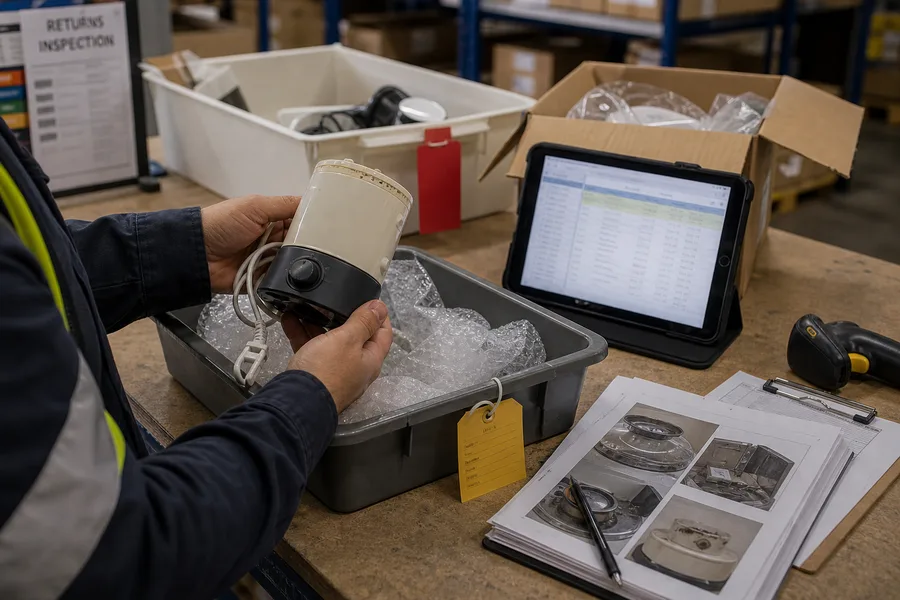
Return patterns can show safety, labeling and quality problems before a platform notice or regulator asks questions. Sellers should turn returns into evidence, not noise.
The signal hidden in customer service
Return data often sits with customer service and finance. Compliance teams see it late, if at all. That split creates a blind spot. Customers may be telling the seller that a product overheats, leaks, breaks, lacks instructions or differs from the listing before any formal complaint arrives.
A single return says little. A pattern says more. If the same SKU creates repeated reasons that point to use, safety, label confusion or product version mismatch, the seller should open a product file review. The return reason has become evidence.
Separate noise from risk
The first task is classification. Size, color preference and buyer remorse belong in a commercial bucket. Broken part, wrong charger, unclear warning, missing manual, smell, heat, leak and injury-adjacent language belong in a review bucket. The seller should not force all returns into the same refund workflow.
The review bucket should connect to supplier and listing records. If customers return a product because an accessory is missing, compare the listing photo with the packing list. If customers say the manual is unclear, compare the current manual with the product version shipped.
| Return pattern | Likely question | File to open |
|---|---|---|
| Wrong accessory | Does the listing match the shipped set? | Listing and packing record |
| Heat or smell | Is there a safety or material issue? | Product test and supplier file |
| Missing instruction | Does the manual match the market? | Manual and label version |
| Repeated breakage | Did production drift from sample? | Batch and inspection record |
Field case: refunds that hide a design issue
A seller refunds a small appliance quickly because the product price is low. The return reason often says difficult to use. Support reads that as customer preference. After several weeks, photos show that customers are using the product without a small safety insert that the listing did not explain clearly.
The product does not need to be recalled to deserve a file review. The seller should update the listing, add a clearer insert, ask the supplier whether packaging changed and keep a decision note. A refund workflow alone would have hidden the defect until the pattern became public.
Turn returns into a review loop
A seller should set thresholds by product risk, not only return percentage. A low return rate can still matter if the reasons point to safety or regulatory claims. High-volume low-price goods may need automated tags; high-risk goods need human review.
The review loop should end with a decision: no action, listing correction, supplier corrective action, product hold or customer notice. Without a decision field, teams keep collecting returns without learning from them.
- Create return reason tags that separate preference from product risk.
- Review repeated risk tags by SKU and batch each month.
- Attach customer photos to the product file.
- Compare return patterns with supplier changes and listing edits.
- Record the final decision and owner after each review.
Practical review step
A useful way to test this issue is to pull one live order, one current product page and one supplier or support file into the same review. The team should ask whether the public promise, the commercial record and the evidence file still describe the same transaction. If one person must search private chats to explain the gap, the control is not ready.
The review should end with a written decision: accept the file as current, correct the public claim, ask the supplier for evidence, hold the next order or assign a follow-up owner. That short decision note turns the article topic into a working record instead of another item on a reading list.
Repeat the same check after any supplier change, listing edit, route change or complaint pattern. The point is not to create paperwork. The point is to keep the commercial file current while the business keeps moving.
Assign the decision to a named role before the meeting ends. If everyone agrees that the issue matters but nobody owns the next record, the risk simply returns to the next order, listing or customer ticket.
Working conclusion
Returns data gives sellers a practical early-warning system. It is messy, but it is close to customer experience and often faster than formal notices.
The seller that reads returns as evidence can correct listings, packaging and supplier files before a platform or regulator frames the issue for them.
Are returns always compliance signals?
No. Many returns are ordinary fit, preference or shipping issues. Repeated product-specific reasons deserve a compliance review.
What should sellers record?
Record SKU, batch, return reason, product version, customer note, photo evidence and the decision made after review.


Leave a comment