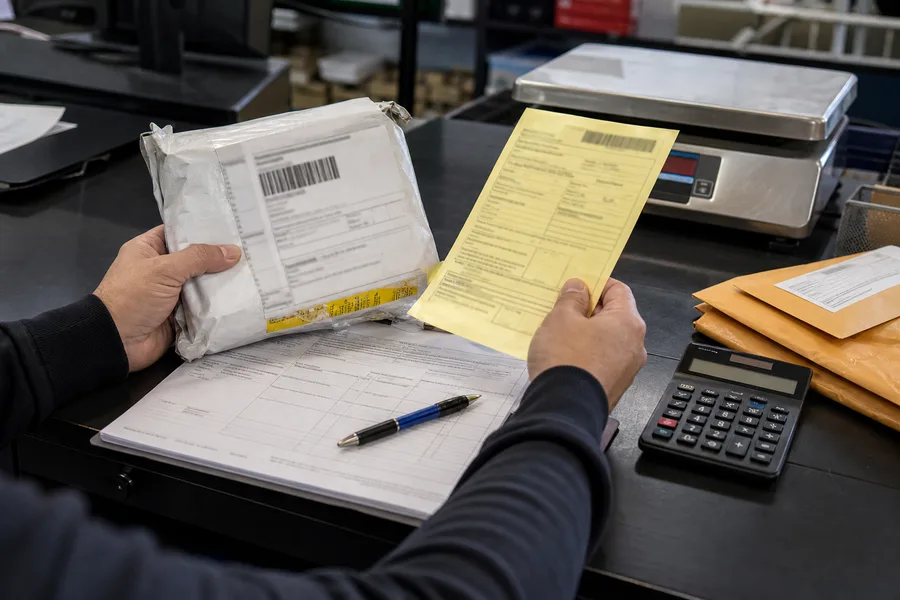
A freight-forwarder change is often handled as a logistics update: a new contact, a revised pickup instruction and a different invoice. It can also change the parties handling cargo, receiving funds, routing goods or providing customs information. For cross-border shipments, the change deserves a short review before the first load moves.
Identify exactly what changed
Record whether the business changed the legal forwarder, local agent, carrier, consolidator, broker, payment recipient or only the operational contact. A familiar brand may operate through different legal entities in different markets. The shipment file should name the entity that contracts, invoices and handles the route for the order concerned.
Compare that information with the booking, commercial invoice, shipping instruction, payment request and customs communication. An unexplained difference does not prove a problem, but it should have a documented commercial reason before funds or cargo are released.
| Change | Question | Record |
|---|---|---|
| New legal forwarder | Who contracts for the service? | Agreement and registration details |
| New payment recipient | Why does this party receive funds? | Invoice and beneficiary check |
| New route or transshipment point | Does it change screening or documentation? | Booking and route note |
| New customs agent | Who may submit information? | Authority and broker instruction |
Screen the parties that touch the transaction
Screening should cover the relevant forwarder entity, agents where appropriate, payment recipient, carrier and any new intermediary named in the instructions. The scope depends on the shipment and applicable rules, but the file should make clear which names were checked and on what date. A generic note that the forwarder was "cleared" is not useful when several companies appear on the documents.
Where a match or uncertainty arises, pause the part of the transaction that depends on the party and seek a qualified review. Do not substitute a slightly different spelling or related company name without recording why it is the same or different party.
Test the first shipment under the new arrangement
Use the first booking as a controlled sample. Check that the pickup party, route, customs filing details, invoice issuer and payment beneficiary match the approved file. Save the booking confirmation and any changed instruction. This small test can catch a mismatch before it repeats across a larger volume of shipments.
After delivery, compare the actual route and final invoice with the plan. If the arrangement changed again during transit, record the reason and decide whether the supplier, forwarder or internal routing process needs a new control.
Keep a release note with the shipment
The release note should name the change, evidence reviewed, owner, remaining limit and next trigger. Review again when the forwarder changes an agent, route, payment entity or customs representative. This gives logistics staff a practical path to follow without turning every booking into a full compliance investigation.
Check route and payment changes together
A new forwarder may propose a different route, agent or payment entity at the same time. Review those changes as one transaction. A route that adds a transshipment location can change documentation needs, while a new payee can change the financial screening question. The shipment file should show which part of the arrangement was approved and which part still requires evidence.
Where the forwarder asks for payment to an affiliate, obtain a written explanation and compare it with the booking, service agreement and invoice. A known logistics brand does not by itself explain why a different entity receives funds.
Preserve the first-shipment evidence
Save the booking confirmation, pickup instruction, carrier record, customs messages, invoice and payment approval from the first shipment. These records show how the new arrangement operated in practice. If cargo is rerouted or another agent takes over, record the date and reason rather than treating the original approval as a blanket authorization.
Review the first completed shipment with logistics, finance and compliance owners. The outcome may support the new forwarder, reveal a documentation gap or show that the operational contact differs from the legal service provider. That short review gives the next booking a stronger basis than a sales introduction.
Keep a contact list for the approved forwarder entity, broker, carrier and payment team. During a shipment exception, staff should know which party can correct a document and which party can authorize a commercial change. This prevents an operational request from being sent to a brand contact who has no legal role in the transaction.
If a route uses emergency alternatives, record the conditions under which they may be used. A contingency plan can reduce delay, but it should not quietly introduce a new payee, intermediary or transshipment point without the review the original route received.
Document the final delivery result and any route deviation. This shows whether the approved forwarder arrangement worked as expected for the shipment concerned.
Keep the route approval current when the forwarder changes a carrier, agent or transit point. A new operational detail can create a new screening or documentation question even when the contract remains the same.