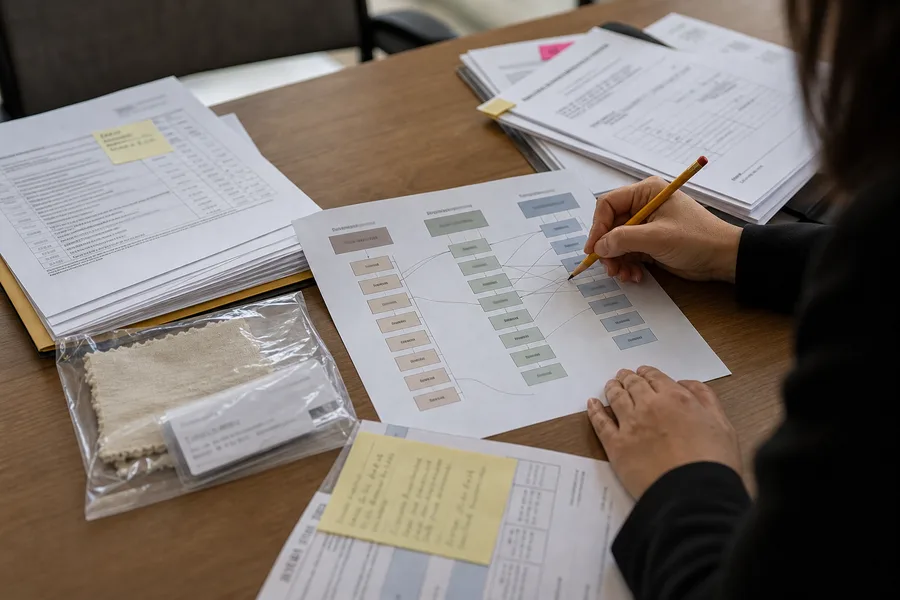
Buyers should label registered office, production site, warehouse and sales office instead of assuming every supplier address must match.
Address roles need labels
Chinese company records may show an office address while production happens elsewhere. That can be normal. Risk appears when the supplier cannot explain which site makes, stores or ships the product.
The verification file should list registered address, production address, warehouse, invoice address and website address with source and role.
Open the note with the live record, not the policy summary. The reviewer needs the affected SKU, account, supplier, route or customer promise, plus the owner who can close the evidence gap. Put the next check in the payment file, not in a separate chat thread.
| Record | Question | Evidence |
|---|---|---|
| Identity record | Which company or file owner controls this point? | Registration, invoice or owner note |
| Commercial record | Does the transaction document tell the same story? | PO, invoice, payment or listing record |
| Evidence gap | What remains unresolved before exposure rises? | Decision note and requested document |
| Review trigger | When should the file reopen? | Supplier, product, payment or complaint change |
Case pattern: office address treated as factory
A buyer uses the registered address as the inspection address. The supplier later says production happens at a partner factory outside the city.
The buyer needed an address role map before arranging inspection.
The owner should record the correction during the same review window. Name the changed fact, the supporting file and the business action that stays on hold. The owner should use the shipment file to mark which fact controls the next step.
Build the address role map
Ask the supplier to label each address and provide production relationship evidence for any factory not owned by the invoice entity.
For high-risk orders, verify the production site instead of only confirming registered address.
- List every supplier address source.
- Label office, factory, warehouse and sales roles.
- Ask for production relationship evidence.
- Use correct address for inspection.
- Update map after address changes.
Refresh trigger: registered address vs production site
Sample one live record instead of rereading the archive. Pick an order, listing, internal note and outside message, then write down whether they tell the same story. Keep the supplier file narrow enough for a buyer, seller or operator to use during a live review.
The review should help the next decision, not produce a long memo. Give the team the mismatch, the owner and the record that needs correction. The claim file should name the record that blocks expansion until proof arrives.
Send the address map to the supplier and ask them to confirm each role in writing.
A negative sample can save time. One rejected document, customer complaint or platform question may show which record the team needs to fix first. Save the source beside the account file so the team can reopen the check without guessing.
A gap in the sample should send the team to the live record. Update the page, invoice, broker note or supplier file before rewriting internal guidance. The broker file should state which order, listing, route or payment term stays limited.
The note should state what will stay small. That limit may apply to order size, listing claims, payment terms, routes or campaign spend. Add the owner to the sample file before the decision moves to another team.
The limit gives the team a control it can check later. The return file should leave the reader with one record to update before the buyer escalation.
Owner handoff: registered address vs production site
Write the handoff for a colleague who was not in the meeting. The note needs the owner, the missing proof, the temporary limit and the next review date. Keep the check short, dated and tied to the certificate file.
Store the handoff where the next reviewer will look. Product notes should sit with the listing and sample file; supplier notes should sit with purchase and diligence records. Use the support file to separate the fact the team knows from the proof it still needs.
The note needs a refresh trigger. A product change, route change, policy update or certificate date can tell the team when to reopen the file. Keep that record in the route file so the next reviewer can see who owns the decision.
Record note: registered address vs production site
Address mismatch is manageable when the buyer knows each address role.
The production site matters most when quality, capacity or inspection rights matter.
Should registered address and factory address match?
Not necessarily. Buyers should label each address and verify the site relevant to the order.
Which address should inspectors use?
Use the production or warehouse address tied to the product, not automatically the registered address.